 English
 中文简体
中文简体The Long Read — Home & Craft
A grounded look at how long solid wood truly holds up in a real bedroom, under real weight, through real seasons.
The Direct Answer: How Long Does a Solid Wood Bed Frame Last?
With normal daily use, a well-built solid wood bed frame can realistically last 25 to 50 years, and in many cases even longer if it is properly maintained. This is significantly longer than particleboard, MDF, or laminate frames, which typically show structural fatigue within 5 to 10 years. The reason for this longevity is simple: solid wood is a continuous, dense material rather than compressed fibers held together with glue and resin, so it resists the daily stress of weight-bearing, movement, and vibration far better over time.
That said, "25 to 50 years" is not a guaranteed number for every frame. Lifespan depends heavily on the wood species used, the joinery method, how the bed is used, and the environment it sits in. A hardwood frame made with mortise-and-tenon joints and cared for properly can realistically become a multi-generational piece of furniture, while a poorly constructed frame made from softer wood may only reach the lower end of that range.
Longevity is not purely about material quality — it is about how consistently a piece of furniture is understood, tightened, and cared for over decades.
Why Solid Wood Outlasts Most Other Bed Frame Materials
To understand why solid bed frames hold up so well, it helps to compare them against the two most common alternatives: metal and engineered wood, such as particleboard, MDF, or plywood composites.
Metal Frames
Metal frames are lightweight and inexpensive, but welded joints can loosen or crack after years of repeated flexing, especially with heavier mattresses or active sleepers. Once a weld fails, the frame usually cannot be repaired and must be replaced entirely.
Engineered Wood Frames
Particleboard and MDF frames use wood fibers bonded with adhesive under pressure. While they look similar to solid wood when finished, they are far more vulnerable to moisture absorption, screw-hole stripping, and sagging under sustained weight. Once the material swells or crumbles around a joint, it typically cannot hold screws securely again.
Solid Wood Frames
A solid wood bed frame is cut from a single piece of timber, or joined boards of the same species, meaning there is no glue layer to fail and no fiber structure to break down. Even when joints loosen slightly over decades of use, they can usually be tightened, reglued, or reinforced rather than replaced.
solid wood bed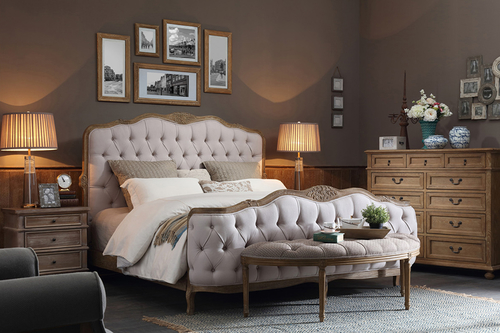
Lifespan Comparison by Wood Species
Not all solid wood is equally durable. Hardness, density, and grain structure all influence how long a frame will resist dents, sagging, and joint fatigue.
| Wood Type | Hardness (Janka Rating) | Expected Lifespan |
|---|---|---|
| Oak | 1,290 lbf | 40–50+ years |
| Maple | 1,450 lbf | 40–50+ years |
| Walnut | 1,010 lbf | 30–45 years |
| Pine | 380–870 lbf | 15–25 years |
| Acacia | 2,300 lbf | 40–50+ years |
Softer woods like pine are still solid wood, and they still outperform particleboard, but they are more prone to surface dents and require slightly more careful handling than dense hardwoods like oak or maple.
Factors That Shorten or Extend the Lifespan
The species of wood is only part of the equation. In practice, several everyday factors determine whether a frame reaches the high end or low end of its expected lifespan.
- Joinery quality: Mortise-and-tenon or dovetail joints last far longer than frames held together primarily with screws and dowels.
- Humidity and climate: Wood naturally expands and contracts with moisture; frames kept in stable indoor humidity, roughly 40–50%, last longer than those in damp basements or rooms with fluctuating temperatures.
- Mattress and sleeper weight: Frames rated for heavier combined weight experience less stress on slats and side rails over time.
- Frequency of disassembly: Repeated moving and reassembly gradually wears down screw holes and joint tightness.
- Finish and protection: A quality sealant or oil finish protects against moisture damage, scratches, and UV fading, extending both structural and cosmetic life.
Note
Indoor humidity between 40% and 50% is generally considered the safest range for solid wood furniture in a bedroom setting.
Does a Solid Wood Storage Bed Last as Long as a Standard Frame?
A common question is whether adding drawers or lift-up storage compromises durability. In general, a well-constructed solid wood storage bed lasts nearly as long as a standard frame, though it carries a few additional stress points worth noting.
Storage beds have moving parts — drawer slides, hinges on lift mechanisms — that wear out faster than the wood itself. However, these components are usually replaceable hardware rather than structural wood elements, so the core frame can still last decades even if a drawer slide needs replacing after 10 to 15 years of heavy use. The main precaution is weight distribution: because storage compartments remove some of the solid support beneath the mattress, it is worth confirming the frame includes a reinforced center rail, particularly for queen and king sizes.
Caution
Without a reinforced center rail, storage beds carrying a queen or king mattress are more prone to gradual sagging in the middle of the frame.
Signs Your Solid Wood Bed Frame Is Nearing the End of Its Life
Even durable frames eventually show wear. Knowing what to look for helps you decide between simple repair and full replacement.
- Persistent creaking that returns shortly after tightening bolts or joints.
- Visible cracks running with or against the wood grain, rather than surface scratches.
- Stripped screw holes that no longer hold hardware securely even after using wood filler.
- Noticeable sagging in the center of the bed frame despite slat or support adjustments.
- Warping severe enough that the mattress no longer sits flat within the frame.
Good to Know
In most cases, minor creaking and loose joints can be fixed with wood glue, corner braces, or replacement bolts, adding several more years of use rather than requiring a new frame entirely.
Maintenance Habits That Maximize Lifespan
Longevity is not purely about material quality; it is also about routine care. The following habits meaningfully extend how long a frame stays structurally sound.
Tighten Hardware Twice a Year
Wood naturally shifts slightly with seasonal humidity changes, which can loosen bolts. A simple twice-yearly check with an Allen key or screwdriver prevents small looseness from turning into structural wobble.
Control Room Humidity
Using a dehumidifier in damp climates, or a humidifier in very dry heated rooms, keeps wood moisture content stable and reduces the risk of cracking or swelling.
Reapply Finish Periodically
Refreshing oil or wax finishes every one to two years protects the wood surface from moisture intrusion and keeps the grain from drying out and cracking.
Avoid Unnecessary Disassembly
Every disassembly and reassembly cycle stresses screw holes slightly. If a frame does not need to move, leaving it assembled preserves joint integrity longer.
Avoid
Dragging a solid wood frame across a floor during moves puts uneven torque on leg joints and is one of the most common causes of premature cracking.
Cost Per Year: Why Longevity Changes the Value Equation
When evaluating whether a higher upfront price is worth it, it helps to calculate cost per year of use rather than sticker price alone. For example, a solid wood bed frame priced at $900 with a 40-year lifespan costs roughly $22.50 per year. A comparable particleboard frame priced at $250 but replaced every seven years costs about $35.70 per year, and that does not include the added cost and inconvenience of repeated replacement, delivery, and disposal.
Viewed this way, solid bed frames are often the more economical long-term choice despite the higher initial investment, particularly for anyone who intends to keep the same bed for a decade or more.
Final Takeaway
Under normal daily use, a quality solid wood frame reasonably lasts 25 to 50 years, with dense hardwoods like oak, maple, and acacia at the higher end of that range. Lifespan ultimately depends less on price and more on wood density, joinery method, and how consistently the frame is maintained. Whether choosing a simple platform design or a functional storage bed, solid wood remains one of the few bedroom furniture materials genuinely capable of lasting a lifetime with reasonable care.